Pickleball Paddle Grip Size: How to Measure Yours in 30 Seconds
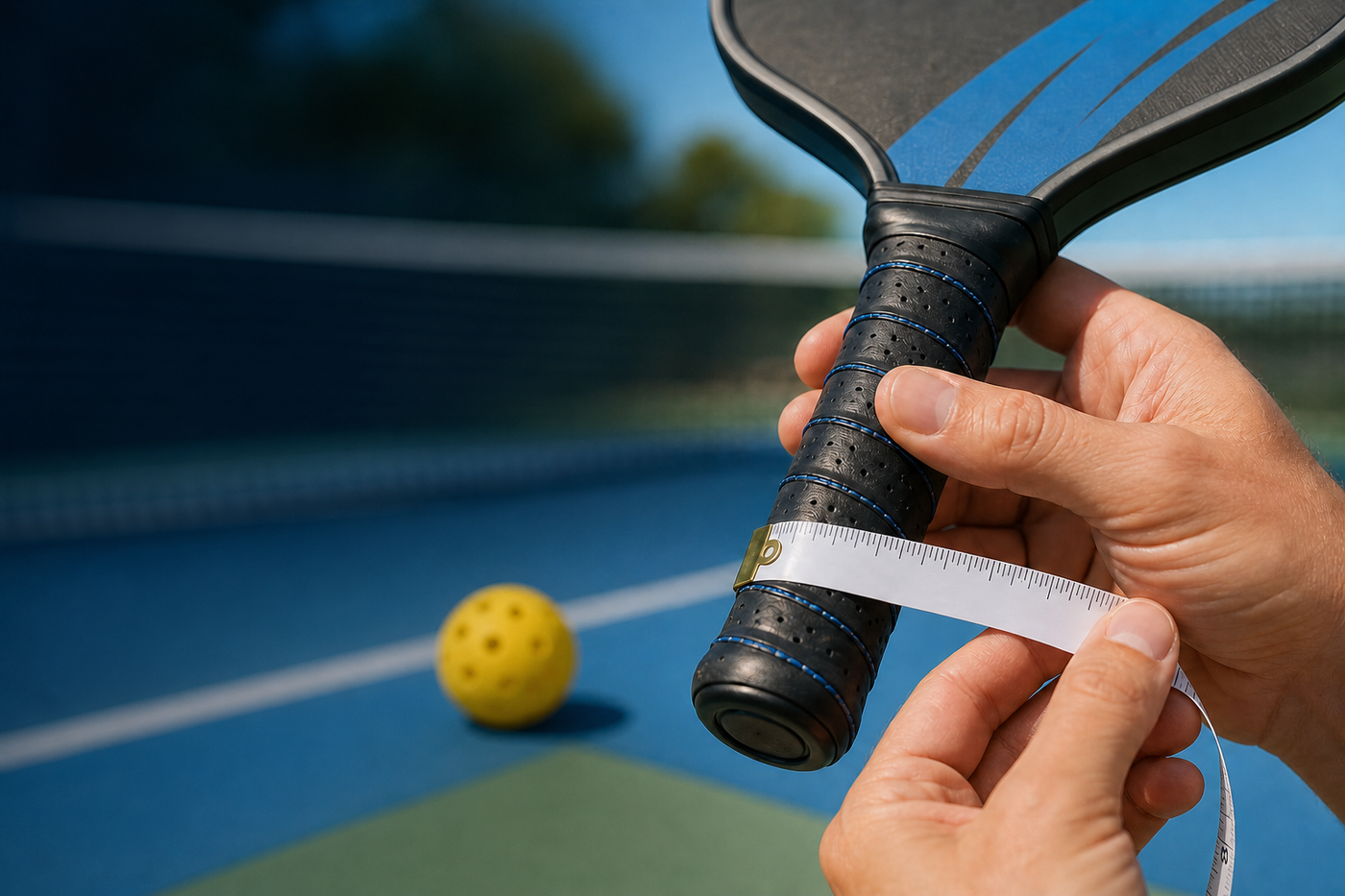
Pickleball Paddle Grip Size: Measure It Before You Buy Anything Else
Pickleball paddle grip size is measured as the circumference of the handle, and it runs from about 4 inches to 4.5 inches. It is the cheapest spec to get right, the cheapest to fix, and the one that causes the most physical pain when it is wrong.
Short answer
Most adults need 4 to 4.25 inches. Hold the paddle in your dominant hand: the index finger of your other hand should just slide into the gap between your fingertips and your palm. When you are between sizes, always take the smaller one, because you can build a grip up in thirty seconds and you can never shrink one.
Two Ways to Measure
Method 1: the finger test (fastest)
Take a normal continental grip on a paddle. Look at the gap between the tips of your ring finger and the base of your thumb. Slide the index finger of your free hand into that gap.
- It fits snugly: correct size.
- It does not fit: grip is too small. This is easy to fix with an overgrip.
- There is room to spare: grip is too large. This is the problem one.
Method 2: the ruler test (more precise)
Open your dominant hand, palm up. Measure from the middle crease of your palm to the tip of your ring finger, in inches. That measurement is a good starting grip circumference.
Palm crease to ring fingertip |
Grip size |
|---|---|
Under 4 inches |
4 inch grip (small) |
4 to 4.25 inches |
4.125 to 4.25 inch grip (most adults) |
Over 4.25 inches |
4.375 to 4.5 inch grip (large) |
Why Too Large Is Worse Than Too Small
An oversized grip forces you to squeeze harder to stop the paddle twisting on off-centre hits. That constant squeeze loads the forearm extensors, and that is the mechanism behind pickleball elbow. It also kills wrist mobility, which is where topspin comes from.
A grip that is slightly too small has the opposite profile: you can hold it loosely, your wrist stays free, and you can add an overgrip to correct it in under a minute. The failure mode is mild; the oversized failure mode is an injury.
Grip is only one of three contributors to a sore arm. The other two are a thin core that transmits shock and a paddle that is too heavy, covered in 14mm vs 16mm core thickness and pickleball paddle weight. Change the grip first: it is the cheapest of the three.
Grip Length Matters Too, and Nobody Mentions It
Handle length typically runs 4.5 to 5.5 inches. It is a separate spec from circumference, and it decides one thing: whether you can play two-handed backhands.
- Under 5 inches: one-handed only for most players.
- 5.5 inches or more: room for a two-handed backhand, common on elongated paddles.
If you come from tennis with a two-handed backhand, check handle length before circumference. A perfect 4.25 inch grip on a 4.5 inch handle will still feel wrong. Handle length travels with paddle shape, which we explain in elongated vs standard vs widebody.
How to Adjust a Grip You Already Own
Each overgrip adds roughly 1/16 inch to the circumference. So:
- One overgrip: 4 inches becomes roughly 4.0625 inches.
- Two overgrips: about 1/8 inch total, plus a softer, tackier feel and a little weight in the handle.
Going the other way is harder. You can remove the factory grip and re-wrap with a thinner replacement grip, which buys back roughly 1/16 inch, but beyond that you are stuck. Our replacement and overgrips cover both directions.
The weight side effect is useful: extra wraps put mass in the handle, which makes the paddle feel faster without feeling lighter. That is the counterweighting trick most players never try.
When to Re-Grip
Grips wear faster than anything else on a paddle, and most players leave them far too long. Replace when:
- The surface goes shiny and slick instead of tacky.
- You notice yourself re-gripping between points.
- The wrap has flattened or started to unravel at the butt.
- It smells. Sweat soaks in, and that is not coming out.
For a player on court twice a week, that is roughly every two to three months for an overgrip. It costs a few euros and changes how the paddle feels more than most upgrades three times the price. If a fresh grip does not fix the feel, the paddle itself may be worn out: see when to replace a pickleball paddle.
Grip size is one of five specs that decide whether a paddle suits you. The other four are in the complete paddle buying guide.
Frequently Asked Questions
What grip size do I need for a pickleball paddle?
Most adults need 4 to 4.25 inches. Measure from the middle crease of your palm to the tip of your ring finger, or use the finger test: the index finger of your free hand should just fit in the gap between fingertips and palm.
Should I size up or down if I am between grip sizes?
Always down. You can add an overgrip in thirty seconds to increase a grip, but you cannot reduce one. An oversized grip is also the most common cause of pickleball elbow.
How much does an overgrip add to grip size?
Roughly 1/16 inch per overgrip. Two wraps add about 1/8 inch, plus extra tack and a little weight in the handle.
Does grip size affect spin?
Indirectly, yes. An oversized grip restricts wrist movement, and wrist snap is a major source of topspin. A correctly sized or slightly small grip leaves the wrist free.
How often should I replace my pickleball grip?
For a player on court twice a week, roughly every two to three months. Replace as soon as the surface turns slick rather than tacky, or you find yourself adjusting your hand between points.