Pickleball Paddle Weight: Light, Mid or Heavy for Your Game?
Pickleball Paddle Weight: The Band You Pick Changes Everything Downstream
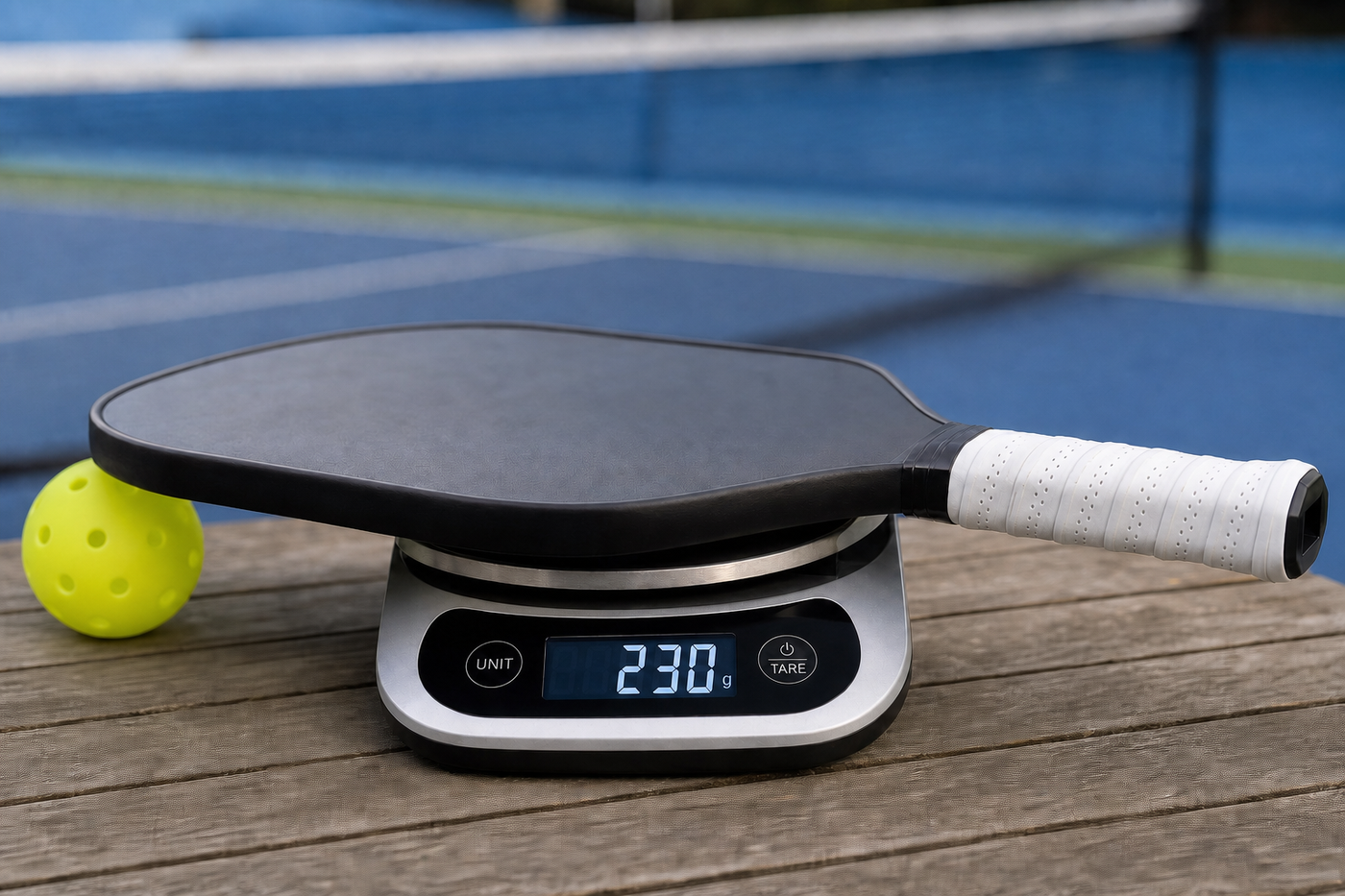
Pickleball paddle weight is measured in ounces and the usable range is tiny, roughly 7.3 to 8.5 oz. That sounds like nothing. In practice, three tenths of an ounce is the difference between winning a hands battle at the kitchen and arriving a fraction late all evening.
Short answer
7.8 to 8.3 oz suits most players. Go lighter if you play doubles and lose points in fast exchanges at the net. Go heavier if you lack put-away power or get pushed around by hard drives. If you have any elbow history, stay in the middle and never go heavy.
What Each Weight Band Actually Does
Band |
You gain |
You give up |
Typical player |
|---|---|---|---|
Light, under 7.8 oz |
Hand speed, quick blocks and resets, less fatigue |
Power, stability when a hard ball arrives |
Net-focused doubles players, smaller frames |
Mid, 7.8 to 8.3 oz |
The balance almost everyone wants |
Nothing specific |
Most rec and improving players |
Heavy, over 8.3 oz |
Put-away power, plough-through on blocks |
Hand speed, and it loads the elbow |
Singles players, big drivers |
Static Weight Is Not Swing Weight
This is the part most listings hide. Static weight is what the paddle reads on a scale. Swing weight is how heavy it feels while you move it, and it depends on where that mass sits.
Two paddles can both weigh 8.0 oz. Put the mass high in the head and the paddle feels sluggish and hits hard. Put it low in the handle and the same 8.0 oz feels whippy and quick. This is why an elongated paddle usually feels heavier than a standard one at identical weight: the mass is further from your hand.
So if a paddle feels wrong but the number looks right, balance is your answer, not weight. We cover shape and balance in the complete paddle buying guide.
The One-Way Rule: You Can Add, You Cannot Remove
Lead or tungsten tape lets you add weight exactly where you want it. Nothing lets you remove weight from a finished paddle. That asymmetry gives a simple buying rule: when in doubt, buy at the lighter end of your range and tune upward.
Where you put the tape matters as much as how much you add:
- 3 and 9 o'clock on the head: more stability and a wider sweet spot, small power gain. The safest first change.
- 12 o'clock at the top: maximum power and plough-through, biggest hit to hand speed.
- Bottom of the handle: counterweight. Raises static weight while making the paddle feel faster, which is the trick most players never try.
Add in small increments, half a gram per side, and play a full session before adding more. Changes that feel subtle in your hand are obvious after an hour.
Your Grip Adds Weight Too
An overgrip weighs roughly 5 to 8 grams, and a replacement grip more. Wrapping two overgrips on a paddle is a real weight change in the handle, which also shifts balance toward your hand.
If you like a slightly thicker handle anyway, this is free counterweighting. Our replacement grips are the cheapest way to change how a paddle feels without changing paddle.
Weight, Core and Your Elbow
Pickleball elbow usually comes from a combination, not a single cause: a heavy paddle, a thin core that transmits shock, and a grip that is too large so you squeeze harder to control it.
If your arm is complaining, change the cheapest variable first, which is grip, then core thickness, then weight. A 16mm core absorbs meaningfully more vibration than a 14mm one, which we explain in 14mm vs 16mm core thickness.
How to Test Weight Without Buying Three Paddles
- Play a normal session with your current paddle and note when you lose points, not just that you do.
- Losing fast exchanges at the net and arriving late? You want lighter, or the same weight with more mass in the handle.
- Getting pushed back on drives, or your put-aways sit up? You want heavier, starting with tape at 3 and 9.
- Fine for an hour then sloppy? That is fatigue. Go lighter, even if the heavier paddle felt better in the first game.
Point 4 catches a lot of people. A paddle that feels great for ten minutes in a shop can be the wrong paddle for a two-hour evening.
Where Our Range Sits
Most paddles in our 16mm carbon collection land in the mid band, around 7.9 to 8.2 oz, because that is where the largest number of players can play their whole session without either sacrificing hand speed or fighting fatigue. If you want to go outside that band, do it deliberately rather than by accident, and browse the full paddle collection with a target number in mind.
Frequently Asked Questions
What is the best pickleball paddle weight for beginners?
Between 7.8 and 8.3 oz. It gives enough mass for stability against hard shots without slowing your hands or tiring your arm over a long session.
Is a lighter or heavier pickleball paddle better?
Neither is better in general. Lighter favours hand speed and control at the net; heavier favours power and stability. Most players are best served in the middle band and should only move out of it for a specific reason.
What is swing weight in a pickleball paddle?
Swing weight is how heavy the paddle feels in motion, which depends on where the mass sits rather than the total. Two paddles of identical static weight can feel completely different if one carries more mass in the head.
Can I add weight to a pickleball paddle?
Yes, with lead or tungsten tape. Adding at 3 and 9 o'clock increases stability and widens the sweet spot; adding at 12 o'clock adds power; adding at the handle butt makes the paddle feel faster. You cannot remove weight, so always buy lighter and tune up.
Does paddle weight cause pickleball elbow?
It contributes, usually alongside a thin core and an oversized grip. If your elbow is sore, change the grip first, then core thickness, then weight.