14mm vs 16mm Pickleball Paddle: Which Core Thickness Suits Your Game?
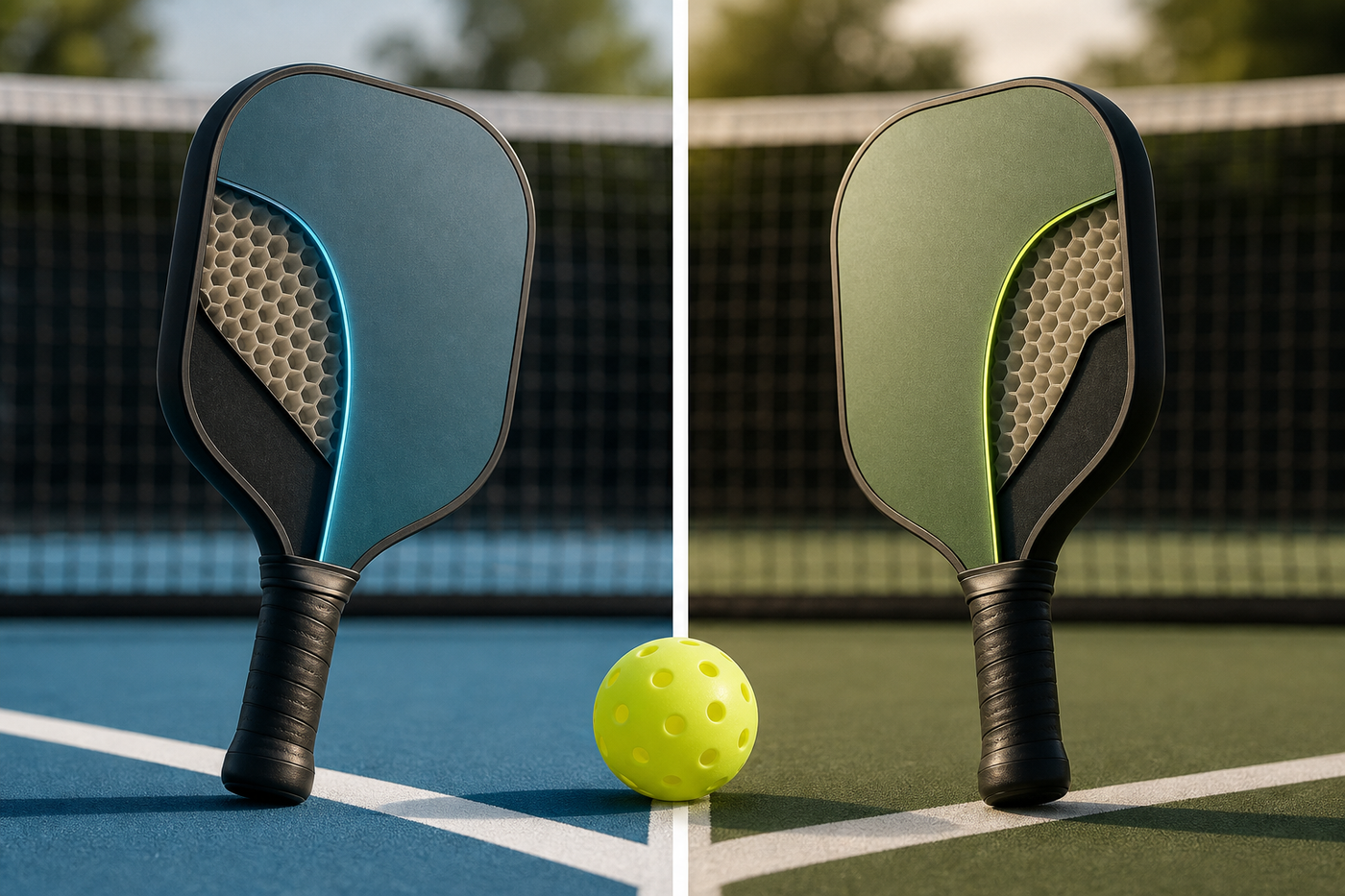
14mm vs 16mm Pickleball Paddle: The Short Version
The 14mm vs 16mm pickleball paddle question comes down to one trade: pop versus dwell. A 14mm core is firmer, so the ball leaves the face faster and hotter. A 16mm core compresses slightly more, so the ball stays on the face a fraction longer, and that fraction is where control, spin and forgiveness come from.
Short answer
Choose 16mm if you want control, touch and a bigger sweet spot. Choose 14mm if you want power and you already have consistent contact. Most players below advanced level improve faster on 16mm, because the errors it prevents cost more points than the power it gives up.
What Core Thickness Actually Is
Every modern paddle is a sandwich: a face, a honeycomb core, another face. The core is almost always polypropylene honeycomb, a grid of small plastic cells. Thickness refers to that middle layer, and it is measured in millimetres.
Thicker means more cells stacked vertically, which means more of the impact gets absorbed by the core instead of bouncing straight back. That is the whole mechanism. Everything below follows from it.
Side by Side
14mm |
16mm |
|
|---|---|---|
Ball feel |
Firm, quick off the face |
Softer, ball sits a beat longer |
Power |
Higher |
Slightly lower |
Control at the kitchen |
Harder to soften |
Easier to drop and reset |
Spin potential |
Good |
Better, more contact time |
Sweet spot |
Narrower |
Wider |
Vibration |
More reaches your arm |
More absorbed by the core |
Suits |
Bangers, singles, confident hitters |
Most rec and improving players |
Why 16mm Became the Default
Ten years ago most paddles were thin. As the sport shifted from "hit it hard" to a soft game built on dinks, resets and third-shot drops, the thicker core became the sensible default, because the soft game is played with dwell time, not pop.
There is a second reason nobody markets: vibration. A 16mm core absorbs more of the shock from off-centre hits. If you play three times a week and your elbow complains, core thickness is one of the first things to change, alongside grip size.
That is why every paddle in our 16mm carbon fiber collection uses the thicker core. It is the less exciting spec on a listing and the one that keeps more balls in play.
When 14mm Is the Right Call
Thinner cores are not obsolete. Pick 14mm if:
- You play singles, where drives and put-aways matter more than kitchen exchanges.
- You are a confident, consistent hitter who rarely mishits and wants free power.
- You are coming from tennis and want a firmer, more familiar response.
- You deliberately want a faster hands battle paddle and will accept the smaller margin for error.
What you should not do is choose 14mm because you feel underpowered. Nine times out of ten, a player who feels underpowered has a contact-point problem, not an equipment problem, and a thinner core will make the mishits worse, not better. If you genuinely need more power, adding weight is the cheaper and more reversible fix, which we cover in pickleball paddle weight.
Does Thicker Mean Heavier?
No, and this trips people up constantly. Core thickness and paddle weight are separate specs. A 16mm paddle can weigh 7.6 oz and a 14mm paddle can weigh 8.4 oz. Manufacturers control weight through face layers, edge guard and handle construction, not just the core.
So if a 16mm paddle feels heavy in your hand, that is the build, not the thickness. Shape plays into this too: an elongated paddle carries mass further from your hand and feels heavier at identical weight, as explained in paddle shapes. The full set of specs sits in the complete paddle buying guide.
What About 13mm and 20mm?
They exist. 13mm shows up in power-first paddles and a handful of thermoformed builds; 19 to 20mm appears in a few control-extreme models. Both are niche. Certification limits paddle length to 17 inches and combined length plus width to 24 inches, but thickness is governed indirectly through power testing rather than a hard millimetre cap, which is why the market has settled around 14 and 16.
Unless you know exactly why you want an outlier, the two mainstream thicknesses cover almost every playing style. Browse the full paddle collection to see where each model sits.
How to Decide in Two Minutes
- Where do you lose points? If it is unforced errors, popped-up dinks and mishits: 16mm. If it is failing to finish put-aways: 14mm.
- Doubles or singles? Doubles rewards the soft game (16mm). Singles rewards drives and reach (14mm).
- Any elbow or wrist niggles? 16mm, without hesitating.
If two of those three point the same way, that is your answer. If they are split, take 16mm: the forgiving option costs you less when you are wrong.
One last thing worth checking before you buy anything. If your current paddle feels dead, the core may simply be worn out rather than the wrong thickness, and a replacement of the same spec will feel like a huge upgrade. The warning signs are in when to replace a pickleball paddle.
Frequently Asked Questions
Is 16mm better than 14mm for beginners?
Yes, in almost every case. The wider sweet spot and extra vibration absorption mean mishits still stay in play, which lets you build consistency instead of fighting the paddle.
Do you lose a lot of power with a 16mm paddle?
You lose some, but less than you would expect. Clean contact on a 16mm paddle produces plenty of pace; most players gain more from the extra control than they lose in raw power.
Which core thickness gives more spin?
16mm, indirectly. Spin comes mainly from the face texture, but the longer the ball stays on the face, the more that texture can grip it, and a thicker core lengthens contact time.
Is a 16mm paddle heavier than a 14mm paddle?
Not necessarily. Thickness and weight are independent specs, and both thicknesses are available across the full weight range. Always check the stated weight separately.
Can I feel the difference between 14mm and 16mm?
Yes, immediately. Most players notice it on the first few dinks: the 16mm feels softer and more muted at contact, the 14mm crisper and livelier.