Carbon Fiber vs Fiberglass vs Kevlar Pickleball Paddle Faces
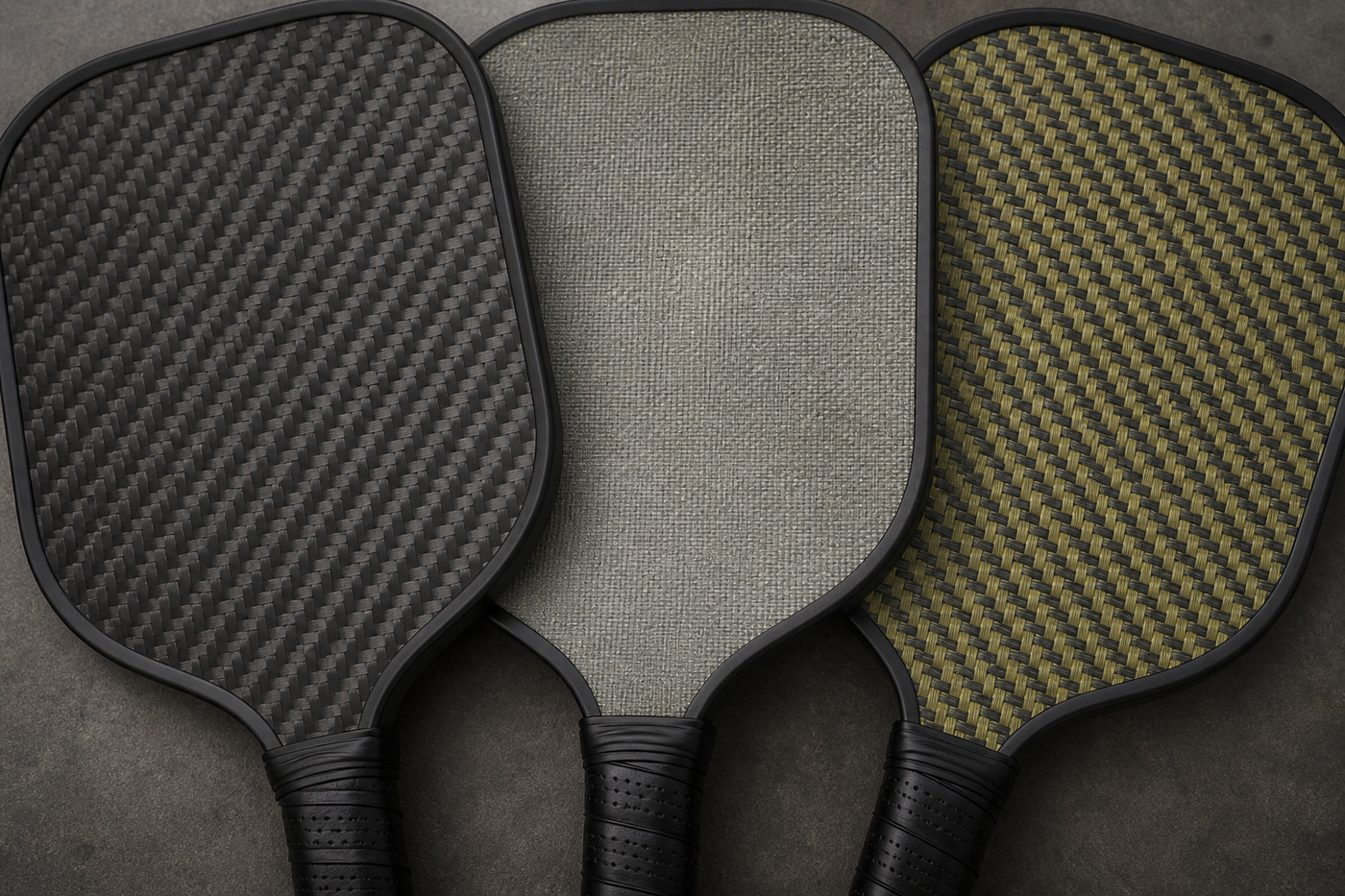
Carbon Fiber vs Fiberglass Pickleball Paddle Faces: What Changes
In the carbon fiber vs fiberglass pickleball paddle debate, the face is the only part of the paddle that touches the ball — so it decides how much spin you can generate, how the paddle feels at contact, and how long that performance lasts before it fades.
Short answer
Fiberglass is softer and cheaper, gives more raw power and less control, and loses its texture fastest. Carbon fiber is stiffer, grips the ball longer for more spin and control, and holds that grip far longer. Kevlar bites hardest of all but transmits more shock to your arm. For most players, carbon is the right answer.
The Three Materials, Side by Side
Fiberglass |
Carbon fiber |
Kevlar |
|
|---|---|---|---|
Stiffness |
Flexible |
Stiff |
Stiff, more damped |
Power |
Highest (trampoline effect) |
Moderate |
Moderate |
Control |
Lowest |
High |
High |
Spin |
Decent when new |
High and consistent |
Highest bite |
Texture life |
Fades fastest |
Lasts longest |
Very durable |
Feel on the arm |
Soft but unstable |
Crisp, predictable |
Harsher feedback |
Typical price |
Entry |
Mid to premium |
Premium |
Fiberglass: Cheap Power, Short Life
Fiberglass (often sold as "composite" or "graphite composite") flexes more at impact. That flex acts like a small trampoline, which is why budget paddles can feel surprisingly punchy straight out of the box.
The problem is what happens next. The flex that gives power also makes the paddle less predictable on touch shots — soft dinks tend to spring off the face rather than settling. And fiberglass surface texture wears smooth quickly under normal outdoor play.
That is the honest reason nearly every sub-$50 paddle uses it. It is not a scam, it is a price point. It is fine for a garden set and frustrating once your soft game develops.
Carbon Fiber: Why T700 and T800 Keep Appearing
T700 and T800 are Toray carbon fiber grades. T800 has higher tensile strength than T700, which lets a manufacturer build an equally stiff face using less material — meaning a thinner, lighter, more responsive face.
What matters on court is that a stiff carbon face does not deform much at impact. The ball rolls across the texture instead of sinking into a flexing surface, and that rolling is what generates topspin. It is also why carbon paddles feel more predictable: less flex means less variation between shots.
Both grades appear across our range — T700 on the 16mm carbon fiber paddles, T800 on the thermoformed models.
How to spot a fake carbon face
This is the single most useful thing in this article. A paddle can legitimately say "carbon fiber" and still play like composite if the carbon sits under a thick layer of paint and clear coat.
- Run a fingernail across the face. A real friction surface has audible, feelable grit. A painted finish feels like a glossy phone screen.
- Look at the weave. On a raw or lightly finished carbon face you can see the fibre pattern, not a printed graphic on top of it.
- Beware heavy graphics. Full-face artwork usually means a print layer, which means the texture is in the ink, and ink wears off.
This is why most of our paddle faces stay visually plain. The texture has to be the surface, not a picture of one.
Kevlar: Maximum Bite, More Feedback
Kevlar (aramid fibre) is rougher and more abrasive than carbon. It grabs the ball harder, which produces the most aggressive spin of the three — genuinely noticeable on slice and heavy topspin dinks.
The trade-off is comfort. Kevlar transmits more impact feedback to your hand and forearm. Many kevlar paddles pair the face with a thicker core specifically to offset this. If you have any history of tennis or pickleball elbow, try before committing.
Does the Face Material Affect Certification?
Indirectly, yes. Certification testing measures surface roughness and power output rather than the material name. A face that is too abrasive fails on roughness; a face that is too lively fails on power. That is part of why roughly 40% of paddles already approved by USA Pickleball failed UPA-A testing in the 2025 cycle — the standards target behaviour, not marketing labels. We break down the details in why paddles fail UPA-A testing.
Which Should You Buy?
- Playing a few times a year, casual only: fiberglass is fine. Do not overspend.
- Playing weekly and improving: carbon fiber. This is the upgrade that changes the most.
- Spin-heavy game, no joint issues: kevlar is worth trying.
- Any elbow sensitivity: carbon on a 16mm core.
Face material pairs with core thickness — the two decide feel together. If you have not settled that yet, read 14mm vs 16mm core thickness, then work through the full paddle buying guide.
Frequently Asked Questions
Is carbon fiber better than fiberglass for pickleball?
For control, spin and longevity, yes. Fiberglass produces more raw power but less predictable touch, and its surface texture wears smooth much faster.
What is the difference between T700 and T800 carbon fiber?
T800 has a higher tensile strength than T700, so manufacturers can build an equally stiff face with less material. In practice T800 faces tend to be thinner and more responsive, and appear on higher-priced paddles.
Does a carbon fiber paddle really produce more spin?
Yes, but because of surface texture rather than the material name. A stiff carbon face lets the ball roll across the grit instead of sinking into a flexing surface. A carbon paddle buried under thick paint behaves like a composite one.
Is a kevlar pickleball paddle worth it?
If your game is built on spin and you have no joint sensitivity, yes — kevlar bites the ball harder than carbon. If you have elbow issues, the extra feedback makes it a poor trade.
How long does a paddle face last?
Roughly one to two years of regular play for carbon, noticeably less for fiberglass. The tell is gradual: less bite on slice, floaty dinks, and a duller sound at contact.