Thermoformed Pickleball Paddles: What They Are and Who Needs One
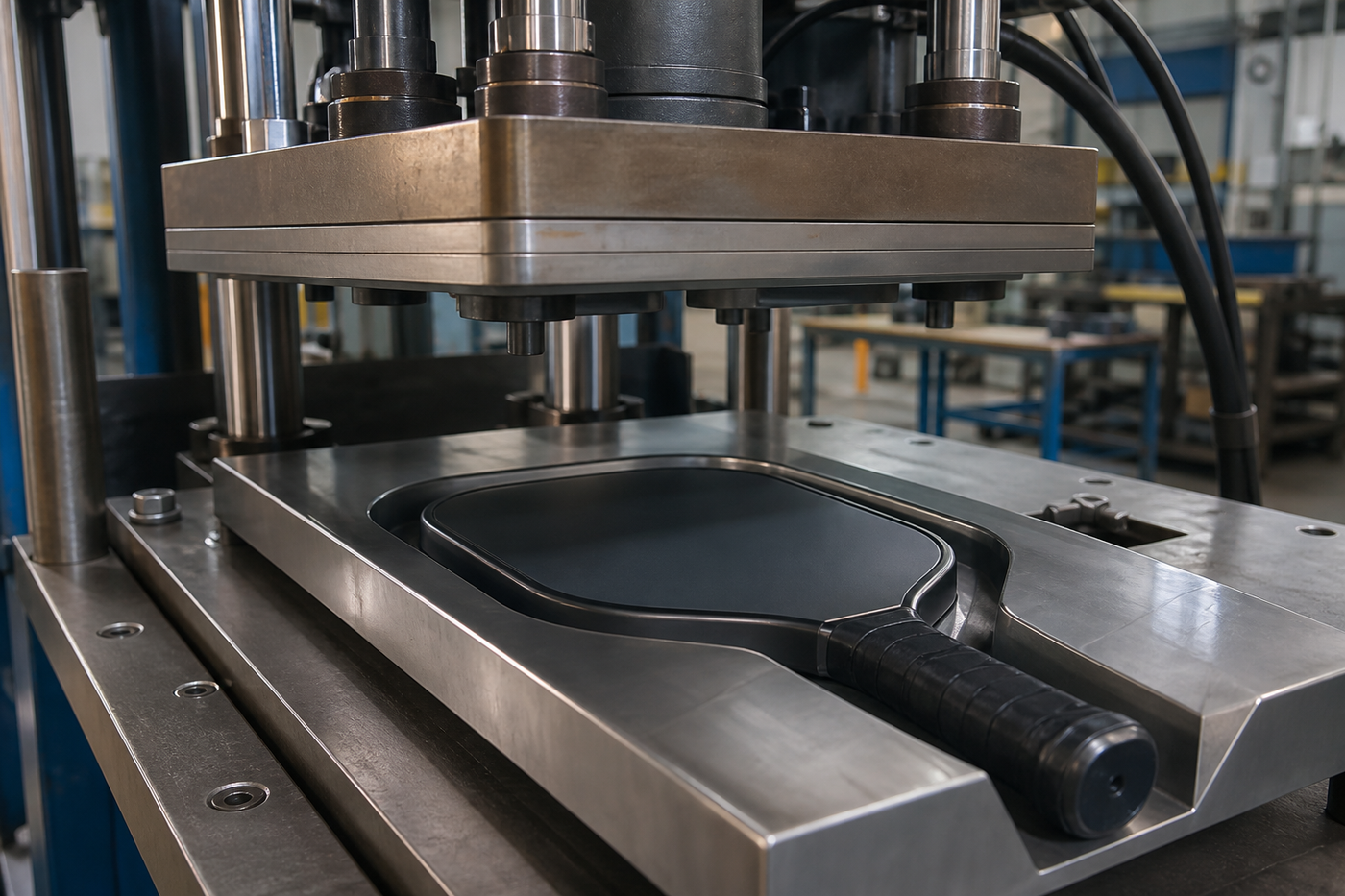
Thermoformed Pickleball Paddles: The Term Explained Properly
A thermoformed pickleball paddle is built as one sealed unit: the faces, core and edge are pressed together under heat so the whole paddle becomes a single piece, usually with foam injected around the perimeter. Conventional paddles are assembled cold, with the faces glued to the core and a separate plastic edge guard clipped on afterwards.
Short answer
Thermoforming buys you more power, a bigger sweet spot and a stiffer, more connected feel. It costs more, it is harder to certify, and the early generation had real durability problems. For most rec players it is a genuine but marginal upgrade, and it is not the first spec you should be shopping on.
What Thermoforming Changes, Physically
|
|
Cold-pressed (conventional) |
Thermoformed (unibody) |
|---|---|---|
|
Construction |
Faces glued to core, edge guard clipped on |
Heat-pressed as one sealed piece |
|
Perimeter |
Hollow at the edges |
Foam-injected walls |
|
Sweet spot |
Concentrated centrally |
Noticeably wider |
|
Feel |
Softer, more muted |
Stiffer, more connected, louder |
|
Power |
Moderate |
Higher |
|
Price |
$60 to $130 |
$150 to $280 |
The foam walls are doing most of the work. In a conventional paddle, a ball struck near the edge hits a hollow perimeter and dies. Fill that perimeter with foam and the same shot keeps meaningful pace, which is why the sweet spot feels so much larger.
The Durability Problem You Should Know About
Early thermoformed paddles, roughly the 2022 to 2023 generation, developed a reputation for cracking at the throat and for going soft after a few months. Two causes: sealing the paddle as one unit concentrates stress where the handle meets the face, and some designs relied on foam that compressed unevenly over time.
Manufacturing has improved since, but the pattern left a legacy: thermoformed paddles are the category where break-in behaviour matters most, because a paddle that gains power as the foam settles can drift outside legal limits.
That is directly why UPA-A testing includes an Accelerated Break-In procedure and caps Paddle Efficiency Factor at 0.405 after break-in rather than out of the box. Roughly 40% of paddles already carrying USA Pickleball approval failed UPA-A testing in the 2025 cycle, and construction that gets livelier with use is a large part of the reason. We unpack that in why 40% of paddles fail UPA-A testing.
Is It Worth the Money?
Be honest about where your points go. Thermoforming gives you power and edge forgiveness. It does not give you a better third-shot drop, a more reliable dink, or a cleaner reset.
- Losing points to unforced errors: a 16mm conventional paddle will help you more, and cost half as much.
- Losing points because you cannot finish: thermoformed is a real answer.
- Playing tournaments: check the certification list before buying, not after.
- Elbow sensitivity: be careful. Stiffer construction transmits more feedback, and the extra power can tempt you into swinging harder.
There is also a straightforward pricing reality. Certification costs $10,000 per brand annually plus $3,000 per model under the 2026 UPA-A programme, and premium paddles carry that. You are paying for construction and for paperwork, which we cover in the UPA-A certification list guide.
What About T800 and Raw Carbon?
Thermoforming is often bundled with T800 carbon faces and raw, unpainted finishes, which is why the terms get used interchangeably. They are separate things. You can have a T800 face on a cold-pressed paddle, and a thermoformed paddle with a mediocre painted face.
Judge the face and the construction independently. The face decides spin, the construction decides power and sweet spot. Our face materials guide covers the first half.
Our Position
We do not chase every generation of construction. A well-built 16mm carbon paddle at $90 covers what most players actually need, and the money saved is better spent on a second paddle, a decent bag or lessons. When thermoformed construction earns its price for a specific playing style, like the T800 build on the Dragon Slayer, we stock it. Otherwise we would rather not sell you the upgrade.
If you are working through the specs in order, the complete paddle buying guide puts construction in its proper place: after core, face, weight, shape and grip.
Frequently Asked Questions
What does thermoformed mean on a pickleball paddle?
It means the paddle is pressed together under heat as a single sealed unit, usually with foam injected around the perimeter, rather than assembled cold with a separate clip-on edge guard.
Are thermoformed pickleball paddles worth it?
They give more power and a wider sweet spot, which helps if you struggle to finish points. If you lose points to unforced errors instead, a conventional 16mm paddle at half the price will help you more.
Do thermoformed paddles break easily?
The 2022 to 2023 generation had a real reputation for cracking at the throat and softening over time. Manufacturing has improved, but it remains the category where break-in behaviour matters most.
Why do thermoformed paddles fail certification more often?
Because sealed foam-injected construction can get livelier as it breaks in. UPA-A tests power after an Accelerated Break-In procedure and caps efficiency at 0.405, so a paddle that is legal out of the box can fail after simulated use.
Is thermoformed the same as T800 carbon?
No. Thermoforming is a construction method, T800 is a carbon fiber grade for the face. They often appear together but they are independent specs and should be judged separately.